

Bauxtie
From mine to port
Nimba Mining Company operates significant infrastructure in Boké province — mine, rail and port — to extract bauxite and move it to Kamsar for export.
Mine
NMC's 690 square km mining concession is located between the towns of Sangaredi and Boké in the northwest of the country. Bauxite deposits are on or near the surface.
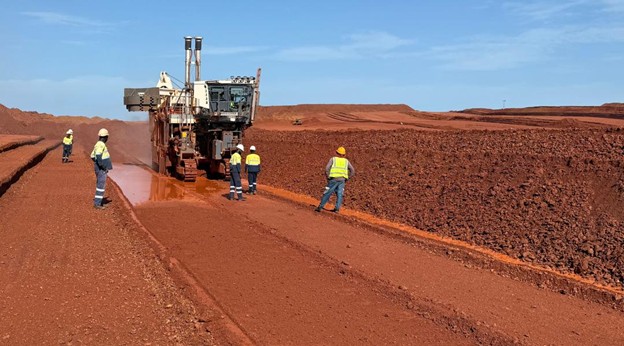
The area to be developed by 2040 contains nearly 400 million tons of bauxite mineral resources. The mine operates 24 hours a day, 365 days a year.
Two technologies are used:
- Surface miners for the extraction and deposit of bauxite, which is then taken back by loader and transported by truck to the ore station.
- Blasting: drillers dig blast holes 140 mm wide according to a predetermined plan. These blast holes are then filled with explosives that are detonated to burst the rock.
The ore is then loaded onto trucks using excavators. Truck drivers empty their dumpers into a crusher, which grinds the bauxite into pieces of 100 mm or less to facilitate transport and handling.
The crushed bauxite is then conveyed at a rate of 2,500 tonnes per hour to a rail stacker, which unloads the ore into one of two stockpiles (each with a capacity of 165,000 tonnes), built parallel to the track for loading into train cars.
Railways
The distance from the mine to the port of Nimba Mining Company is about 86 kilometres, and we use shared rail infrastructure to transport our bauxite ore to the coast.
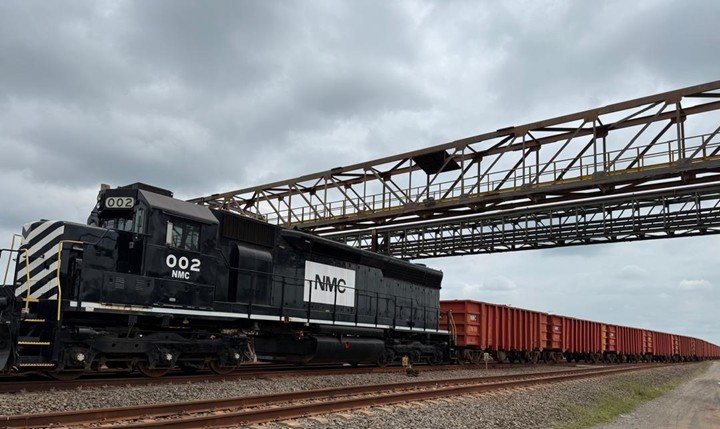
Each ore train consists of three locomotives and a maximum of 150 cars. Each wagon can hold 86 tons of ore.
The train is loaded from the mine's storage area by a fleet of four front-end loaders. The loading rate is equivalent to less than two minutes per wagon.
When fully loaded, the trains can carry nearly 12,900 tons of ore, the weight of the Eiffel Tower. It takes about three hours to reach the coast.
Port
NMC's port is in Kamsar, near the mouth of the Rio Nunez River. It takes less than three hours to unload each train. We use a wagon tippler that lifts and unloads the wagons, two by two, while remaining connected to the train.
The bauxite is transported by conveyors to a storage area with a capacity of 1,300,000 tons. The storage area is equipped with a powerful bucket wheel that ensures storage or retrieval of bauxite at a speed of 4,500 metric tons per hour.
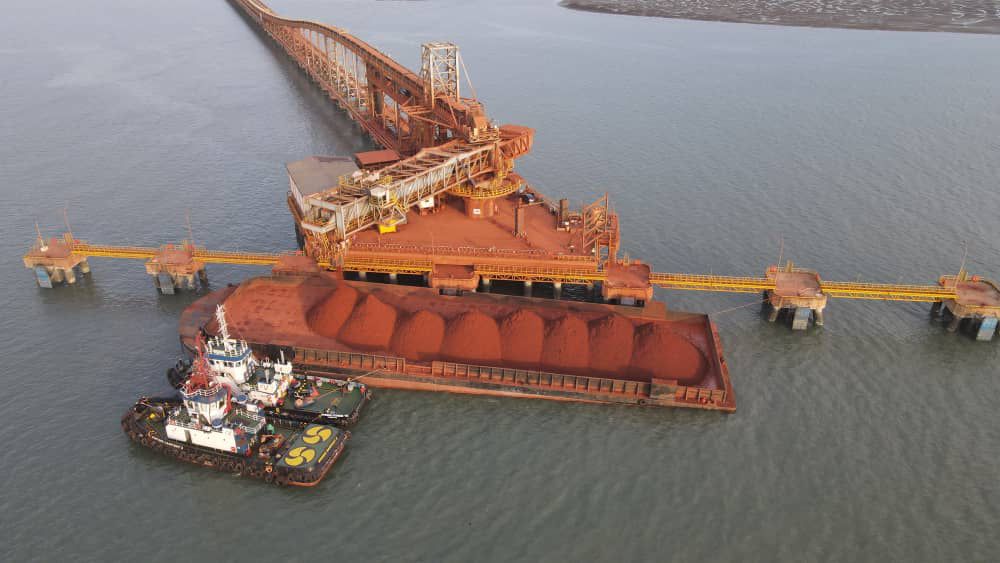
A network of underground and overhead conveyors is then used to transport the bauxite to the barge loader at the end of a 1.5 km jetty. It takes the shipper, with a capacity of 5,000 metric tons per hour, two hours to fill a 10,000-ton barge.
The barges transport the bauxite ore to the transshipment site, located 40 kilometres away, in deeper waters. This allows the use of Capesize vessels for maritime transport. Capesize vessels are about 300 meters long and 50 meters wide and can carry nearly 180,000 tons of bauxite.
At the transshipment point, floating cranes with backhoe bodies are moored on either side of the ocean-going vessel, allowing bauxite to be transferred directly from the barge to the export vessel. It takes about four and a half days to load a Capesize vessel.